
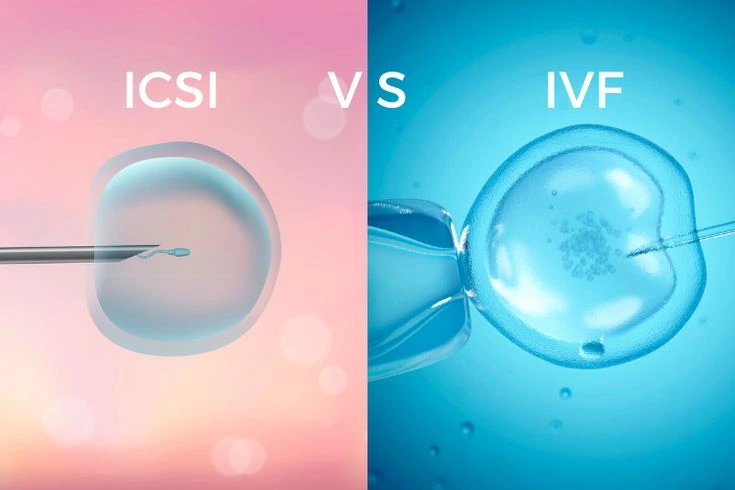
Whenever a student is considering a career in fertility science, two more concepts keep being repeated to them: IVF and ICSI.The question arises as to which one is more important and what they are supposed to actually pay attention to during their IVF training or ICSI training. This blog describes the pure distinction in simple English, more importantly, what the actual distinction of being an embryologist in real lab life depicts.
Exploring IVF:
IVF (In Vitro Fertilization) is a fertility technique in which oocytes and sperm are introduced into a test tube in the laboratory so that fertilization can take place in a natural way.
The IVF training for an embryologist consists of:
- Handling eggs and sperm
- Preparing culture media
- Monitoring fertilization
Development of the embryo at its early stages.
IVF is one of the first methods that students get acquainted with when they are training in clinical embryology, since it teaches students the principles under which embryos grow in the laboratory.
What is ICSI and it’s Difference?
A more advanced technique is the ICSI (Intracytoplasmic Sperm Injection). One sperm is also injected into a single egg with specialised micromanipulation apparatuses rather than left to fertilise the egg.
ICSI training instructs embryologists:
- Accurate manipulation under the microscope.
- Use of micromanipulators
- Advanced lab discipline
- Decision making that is very much responsible.
The ICSI technique is mainly applied to male infertility or a failed IVF attempt.
IVF vs ICSI: What a difference as an embryologist?
In the eyes of a student, there is a possibility of similarity between IVF and ICSI. However, within the laboratory, things are much different in terms of the embryologist.
In IVF Training
- Attention is given to natural fertilisation.
- High culture and development of the embryo.
- Develops background laboratory work.
In ICSI Training
- Emphasis is put on technical expertise and precision.
- Demands must have steadfast hands and concentration.
- Expects greater responsibility and experience.
They both are critical, though they find different uses in the career of an embryologist.
Which Training is more vital to Students?
Many students ask,
However, which one between IVF training and ICSI training should I take?
The sincere reply would be: you must have both of them, but in the correct sequence.
IVF training aids you in knowing what embryology is all about.
High-technical confidence is developed with the ICSI training.
An excellent embryology training program presents the concepts of IVF initially and progresses to ICSI training as soon as the foundations are well understood.
What Nobody Tells Students about ICSI Training?
An IVF lab can be no ordinary work in a laboratory. You deal with human non-germ cells. An error of any considerable size can have an impact. Cleanliness and accuracy are very crucial.
- ICSI is very impressive, but it is not the thing a beginner should hurry about.
- It takes time and practice.
- Errors may also influence the fertilisation process.
- Training is only guided to bring confidence.
This is the reason why appropriate supervision in the training of ICSI is highly significant among students.
The role of IVF and ICSI Training in Career Development.
In a real IVF clinic, embryologists will be expected to:
- Learn IVF laboratory procedures.
- Assist in ICSI procedures
- Monitor embryo development
Those embryologists who go through IVF training and also the embryologists who go through the training of ICSI have better career prospects and can fit in well in various laboratories.
What do you want to learn in a Training?
A course you are taking should:
- Both the IVF and ICSI concepts have been covered.
- Describes techniques in basic English.
- Practical laboratory exposure is provided.
- Develops trust on a foundation.
Veterans should not subscribe to purely theoretical programs that offer to impart highly advanced skills without a sufficient foundation.
Career Opportunities In a Post Embryologist:
Once they have completed a structured course on embryology, they can decide to work in jobs, including:
- Clinical Embryologist
- IVF Lab Technologist
- ART Lab Assistant
- Fertility laboratory assistant.
Through experience, practitioners will be able to become senior embryology specialists in the IVF centres.
The future of the career in clinical embryology is significantly expanding as a result of the rising cases of infertility and the rise in the number of fertility clinics being established in India.
Does IVF vs ICSI Really Matter?
To an embryologist, there should be no IVF vs ICSI.
- It is concerning learning the right way.
- IVF training develops your foundations.
- The training in ICSI enhances your competency.
They both get you ready to practice IVF in a lab environment that is real and a pregnancy that grows long-term in a fertility clinic.
When you are serious about being an embryologist, make a training choice that honours this balance.