
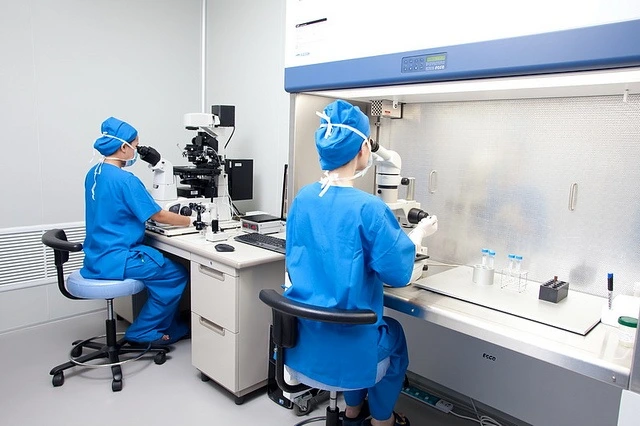
This is one of the questions that will emerge in your mind should you consider a career in IVF or fertility science:
Should I take a PG diploma course in clinical embryology or a short course, IVF training course?
Both options sound good. They both hold the future of IVF labs. However, they are not identical and selecting one
of them improperly may waste time, money and motivation.
I would like to break it down in an easy way so that students are able to make a decision.
What is a PG diploma in clinical embryology?
PG diploma in clinical embryology is a course provided over a long period of time. It is concerned with profound theoretical awareness as
well as organised hands-on exposure.
Students who opt to choose this option normally do so because they:
- Desire a good academic background.
- The long-term career plans in IVF and ART.
- Would like to work in research or senior embryology positions.
PG diploma provides you with profound knowledge of embryo development, laboratory science, and assisted reproductive technology.
What Is a Short-term IVF Training Course?
A short-term training program in IVF is primarily based on practical skills. It is set to immediately expose students to the IVF laboratory and actual practice.
Students should be able to attend IVF training courses because they:
- Need to be seen sooner in the IVF labs.
- Possess a science or medical background already.
- Wants practical knowledge as opposed to theory.
Such courses tend to be shorter in duration and skill-based.
Theory or Practice?
It is to this extent that most students are confused.
PG Diploma in Clinical Embryology
- Good theoretical basis.
- More detailed learning
- Longer duration
- More beneficial in the long-term academic development.
Short-term IVF Training
- Practical-focused learning
- Faster skill exposure
- Shorter duration
- Ideal for quick career entry
- Neither is necessarily better in all people.
The proper decision here will be based on your past and professional aspirations.
What students often don’t realise?
Here’s the truth.
- A PG diploma that is not accompanied by good practical exposure may be deemed as a whole.
- Basic theory may be necessary to confuse IVF training.
- Informed learning occurs when practice and theory have an interface.
Some students start with IVF training to learn about lab work, after which they pursue a PG diploma in clinical embryology. Some are given
the diploma first and then trained in hands-on training in IVF.
Both paths can work.
Which one is simpler to use as a beginner?
If you are new to the field of IVF, and want to:
- Learn the principles of how the IVF labs operate.
- Observe embryo development.
- Grow confidence and then make commitments that are long-term.
Then, a good starting point may be short-term IVF training.
Suppose you realise that it is your career and desired:
- In-depth knowledge
- Academic strength
- Long-term growth
PG Diploma in Clinical Embryology could be the correct option
Is There Greater Scope?
A postgraduate diploma in clinical embryology usually offers chances in:
- Senior embryologist jobs (experience required).
- Research and teaching
- Complex ART duties.
IVF training helps with:
- Opening levels of work as an embryologist or laboratory assistant.
- Clinical confidence in practice.
- Being aware of effective lab expectations.
As it happens in practice, the name of courses is not valued in IVF clinics as much as skills, discipline, and lab confidence.
Conclusion
The decision between a PG diploma in clinical embryology and IVF training does not come down to the matter of right or wrong.
- It’s about the right timing.
- Begin where you can feel comfortable.
- Learn properly.
- Build skills step by step.
No course is sufficient to make a successful embryologist, but it is continuous learning, patience, and actual lab experience.